Perplexity rewards accessible, current, answer-focused content.
Getting cited by Perplexity depends heavily on real-time crawlability, content freshness and answer clarity. Perplexity retrieves information from the live web for every query rather than relying mainly on a fixed training snapshot.
That difference matters.
The tactics that improve Perplexity citations aren’t identical to those you might use for ChatGPT or a traditional Google AI Overview. Treating all three platforms the same can send your effort toward the wrong priorities.
This guide explains what makes Perplexity’s citation behavior different, how it chooses sources, and the practical steps that can move a business from invisible to cited.
How Perplexity Is Different From ChatGPT and Google
Perplexity relies on real-time retrieval by default. When someone searches, Perplexity performs a live web search and generates a response with inline citations to the specific sources it used. Those citations appear directly in the answer.
That works differently from ChatGPT when it answers from training data without browsing. It also differs from traditional Google search, where the citation and ranked result effectively point to the same page.
Perplexity gives businesses another opportunity. A company can earn a citation even without a particularly strong Google ranking if its content remains current, accessible, and clearly relevant to the query at the moment someone asks it.
How Perplexity Decides What to Cite
Real-Time Crawlability
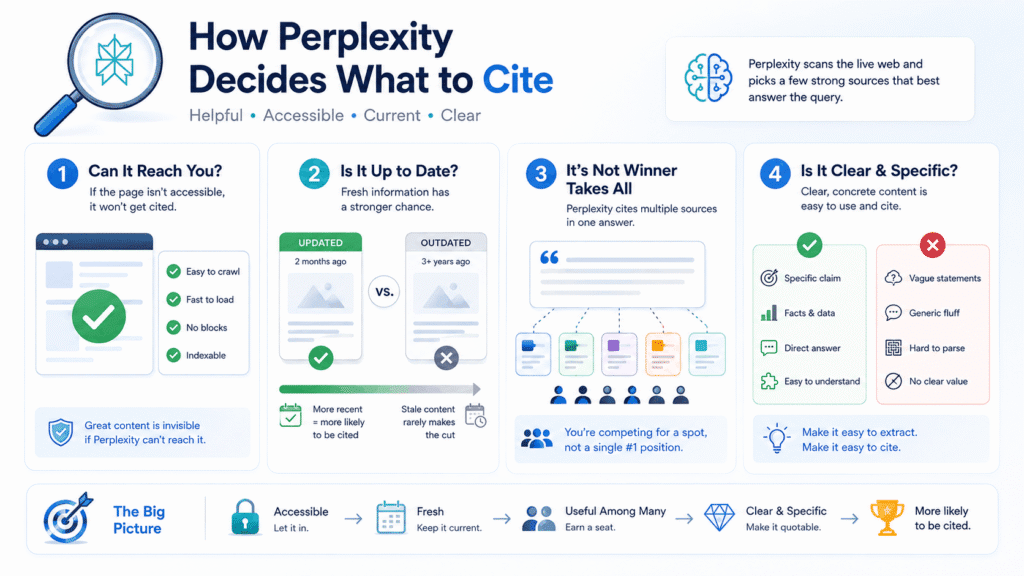
Perplexity retrieves information from the live web. So if a page is blocked, slow, or difficult to access when someone runs the query, Perplexity has little chance of using it.
That makes technical accessibility especially important. Relevant pages need clean crawlability, reasonable load times, and no blocking directives that prevent retrieval.
A great page can’t earn a citation if Perplexity can’t reach it.
Content Freshness
Freshness matters more directly for Perplexity than it does for answers that rely primarily on training data.
Imagine two pages covering the same subject. One received an update within the past few months. The other hasn’t changed in years. Even if the older page once ranked well elsewhere, the recently updated page can make the stronger retrieval candidate.
Source Diversity Within a Single Answer
Perplexity typically cites several sources within a single response rather than choosing one winner.
That changes the competitive landscape. You’re generally competing for inclusion among a handful of credible, current sources rather than fighting for one exclusive position.
The threshold may be lower than a winner takes all ranking system, but you still need to provide something useful enough to cite.
Content Clarity and Specificity
Generative systems need something concrete to extract.
A page that makes a specific, accurate claim gives Perplexity usable material for its response. A page filled with vague marketing language doesn’t.
The principle is simple: make the information clear enough that the system can understand exactly what you’re saying and why it matters to the query.
Step-by-Step: How to Get Cited by Perplexity

Step 1: Test Your Current Baseline
Start with the questions your buyers actually ask.
Enter those questions directly into Perplexity and check whether your business appears among the cited sources. Run each query a few times because retrieval results can vary between sessions depending on what Perplexity currently finds and accesses.
Step 2: Confirm Real-Time Technical Accessibility
Check the pages you want Perplexity to cite.
Make sure they load quickly, remain fully crawlable, and don’t contain blocking directives that prevent real-time retrieval. This matters particularly for Perplexity because an inaccessible page has no practical path to citation during a live search.
Step 3: Keep Priority Content Current
Identify the pages that answer your buyers’ most important questions.
Then review and update them regularly. You don’t necessarily need to rewrite the entire page every time. Even relevant, meaningful updates can keep important content current instead of letting it sit untouched after publication.
Freshness matters directly to Perplexity’s retrieval process.
Step 4: Rewrite for Direct, Specific Answers
Make the answer easy to find.
Restructure important sections so they provide a clear, specific answer near the beginning. This follows the same content-clarity principle discussed in How to Get Cited by ChatGPT, although the retrieval mechanics differ between the platforms.
Step 5: Build Off-Site Corroboration
Don’t rely entirely on your own website to establish important claims about the business.
Perplexity, like other generative engines, can look at whether information appears consistently across independent sources. Accurate listings on review platforms, industry websites, and other credible third-party sources can strengthen the credibility signals surrounding your business.
Step 6: Re-Test on a Recurring Basis
Repeat the Step 1 test regularly using the same query set.
Track whether your citation frequency increases, stays flat, or declines. There isn’t a standard analytics dashboard that gives you this information, so direct testing remains the most reliable way to measure changes.
Step 7: Watch for Query-to-Query Variation
Live retrieval creates another variable: wording.
A buyer can ask essentially the same question in two slightly different ways and receive different sources. Test several versions of important buyer questions rather than relying on one exact phrasing.
Otherwise, you might mistake a single query’s result for the full picture of your citation performance.
Common Mistakes That Prevent Perplexity Citations
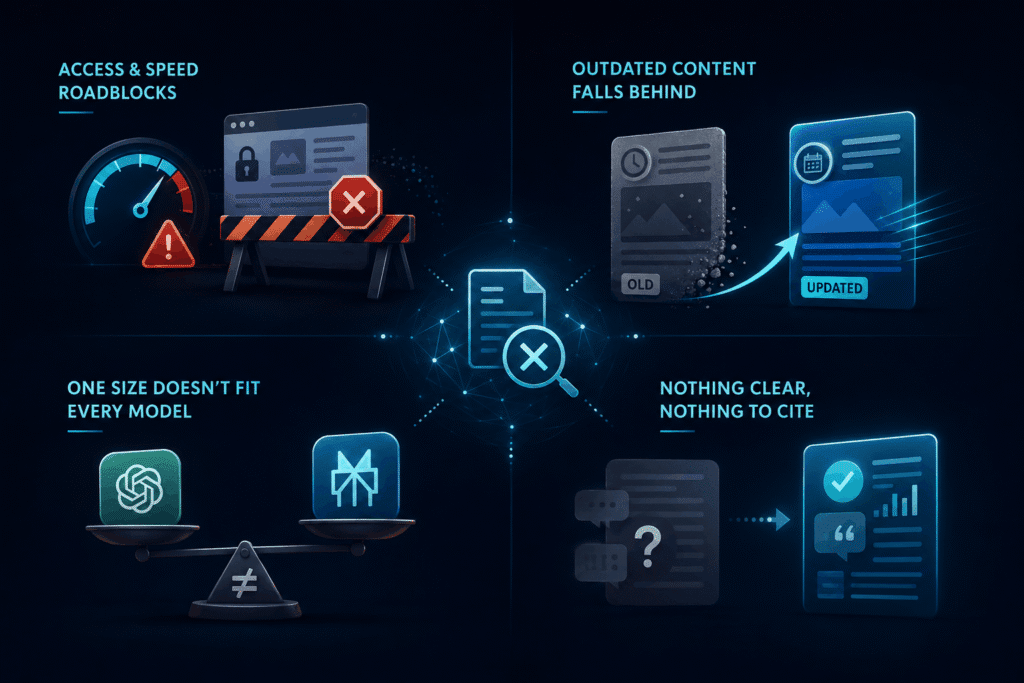
- Blocking or slow-loading pages. Perplexity can’t retrieve and cite information it can’t access quickly and cleanly.
- Letting priority content go stale. A page that hasn’t changed in years can become a weaker retrieval candidate than a recently updated page covering the same topic.
- Assuming ChatGPT citation strategy transfers directly. The content principles overlap, but Perplexity’s real-time retrieval model places greater weight on freshness and technical accessibility.
- Using vague, promotional content with nothing specific to extract. If a page doesn’t make clear, useful claims, Perplexity has little concrete information to cite.
How TechRix Solutions Approaches Perplexity Citation Strategy
Perplexity-specific citation work at TechRix Solutions starts with baseline testing.
The team first checks the questions that matter to the business and identifies which sources Perplexity currently cites. From there, the work adds the technical accessibility and content-freshness checks that matter specifically to a real-time retrieval platform.
The process runs as part of the broader LLM Citations services engagement rather than as an isolated platform-specific tactic.
Frequently Asked Questions
Is getting cited by Perplexity the same as getting cited by ChatGPT?
No.
Perplexity retrieves information from the live web on every query and visibly cites the sources it uses. ChatGPT’s citation behavior depends heavily on whether browsing is enabled for that response.
The content-clarity principles overlap, but the technical and freshness requirements differ.
Does my page need to rank on Google to be cited by Perplexity?
Not necessarily.
Perplexity’s real-time retrieval means a technically accessible, current, clearly written page can earn a citation without a strong existing Google ranking. A strong Google ranking can still provide useful corroborating evidence, but Perplexity doesn’t require it as a prerequisite.
How often does content need to be updated to stay competitive for Perplexity citations?
There’s no fixed interval.
Priority pages that answer frequently asked buyer questions should receive periodic reviews and relevant updates rather than sitting untouched indefinitely after publication.
The right frequency depends on how quickly the subject changes and how important the page is to your business.
Can a small business realistically get cited by Perplexity?
Yes.
Real-time retrieval and content freshness can matter more than raw domain authority for a particular query. That gives a smaller, well-maintained site an opportunity to appear alongside or instead of a larger competitor with stale content.
How do I check if Perplexity is currently citing my business?
Ask Perplexity the real questions your buyers would ask and inspect the citations attached to the response.
Repeat the test periodically. Results can change as new content enters the index and Perplexity retrieves different sources.
Find Out Whether Perplexity Is Already Citing You
Most businesses have never asked Perplexity the same questions their buyers ask before deciding who to trust.
A free AI visibility audit from TechRix Solutions runs those tests directly and shows exactly where your citation gap sits.