
Start with clarity, not content volume.
GEO for a growth-stage startup should focus first on clear entity positioning, specific and quotable content, and early off-site corroboration, in that order.
Why? Most startups don’t have the content library, backlink history, or established authority that standard GEO advice quietly assumes. Much of the published advice targets businesses that have spent years building content and domain history.
A startup starting from near-zero needs a different sequence. It doesn’t need a smaller version of an established company’s GEO strategy.
This guide explains what changes for startups, where limited budgets should go first, and what you can deliberately leave for later.
Why GEO Matters Especially for Startups
Startup buyers, particularly in SaaS and B2B categories, already use AI tools heavily. Many feel comfortable asking ChatGPT or Perplexity to compare products instead of visiting five separate review sites.
That changes where discovery happens.
A startup can become part of the conversation inside a generated answer before it has built the traditional SEO authority that would normally support strong search visibility.
There’s another advantage. A startup starting from zero has less legacy content to clean up, fewer inconsistent off-site mentions to correct, and a genuine chance to build GEO into its content from day one instead of retrofitting it onto years of generic marketing copy.
How GEO Differs for a Startup vs an Established Business
An established business usually has existing content to restructure and years of off-site information to clean up.
A startup doesn’t.
It builds both from scratch while working with a tighter budget and no content backlog. That changes the order of operations.
An established business might begin with a content audit. A startup usually needs to begin by defining exactly what it is and what it does.
Established companies often have that entity clarity simply because they’ve existed for years. Startups have to create it deliberately.
The GEO Priorities That Matter Most at the Startup Stage
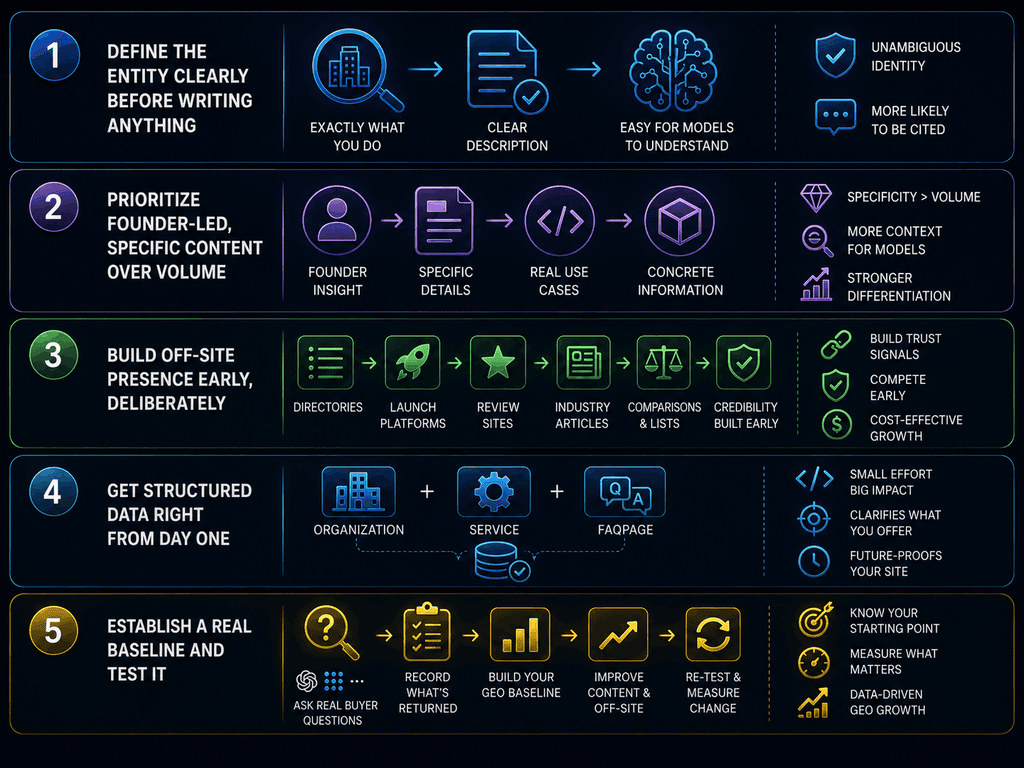
1. Define the Entity Clearly Before Writing Anything
Before writing content, a startup needs one unambiguous answer to a basic question:
What exactly is this business and what does it do?
Don’t settle for a tagline. Write a specific description that a model could repeat accurately without confusing the company with a competitor.
A clever positioning statement might work well in a pitch deck while remaining too vague for a generative engine trying to categorize the business.
2. Prioritize Founder-Led, Specific Content Over Volume
A startup with limited resources will usually get more from a small collection of specific, founder-informed pages than from publishing generic articles simply to fill a content calendar.
Specificity gives a generative engine something concrete to work with.
Real capabilities. Real use cases. Real technical details. Those details give models information they can understand and potentially cite. More on this appears in What Is GEO?.
Publishing more content doesn’t automatically solve the problem if every page says roughly the same thing as every competitor.
3. Build Off-Site Presence Early, Deliberately
A startup doesn’t have years of backlinks and mentions to support its credibility.
That makes early off-site presence particularly valuable. Accurate listings on relevant directories, launch and review platforms, and comparison content within the category can start building corroboration from a genuine blank slate.
This can also become one of the most cost-effective early GEO activities. You’re establishing external signals rather than spending months cleaning up inconsistent information later.
4. Get Structured Data Right From Day One
Add accurate schema markup from the first version of the website where it genuinely applies.
Organization, Service and FAQPage schema can help clarify what the business represents and what its pages contain.
The technical investment remains small at this stage. More importantly, you avoid the retrofit work established businesses often face after years of inconsistent implementation.
5. Establish a Real Baseline and Test It
Start testing early.
Ask ChatGPT and Perplexity the actual questions your buyers would ask and record what they return. That gives you a baseline you can measure as your content and off-site presence grow.
Without that baseline, you won’t know whether your GEO investment actually changed your visibility.
How to Choose Which Off-Site Platforms to Prioritize First
Not every directory, review platform or comparison site deserves your attention.
A startup has limited time and money, so spreading effort across every available platform usually produces thin results. Focus on the platforms that actually matter in your category.
- Start with platforms buyers already use to compare options. Look for industry-specific review sites, marketplaces, and comparison hubs rather than general-purpose directories with little connection to the buying decision.
- Check where competitors consistently appear. If credible competitors all maintain profiles on the same platform, that platform probably carries a meaningful category signal. A platform with sparse or low-quality listings across the industry deserves less attention early on.
- Prioritize accuracy over breadth. A few complete, consistent, accurate listings on the platforms that matter most can do more for a startup than dozens of rushed or inconsistent profiles scattered across every directory.
What Startups Should Not Prioritize Yet
- Chasing content volume before establishing entity clarity. Publishing quickly without first defining the business clearly creates content that a model may struggle to attribute correctly.
- Ignoring SEO fundamentals entirely. GEO still relies on a website that search engines can crawl, index, and understand. The same principle discussed in SEO for Startups and GEO vs SEO applies here.
- Copying enterprise-level content calendars. A publishing schedule designed for a company with dedicated content resources rarely fits a founder-led startup. Trying to maintain one often produces generic, low-specificity content, exactly what GEO needs less of.
A Practical Starting Sequence for Startup GEO
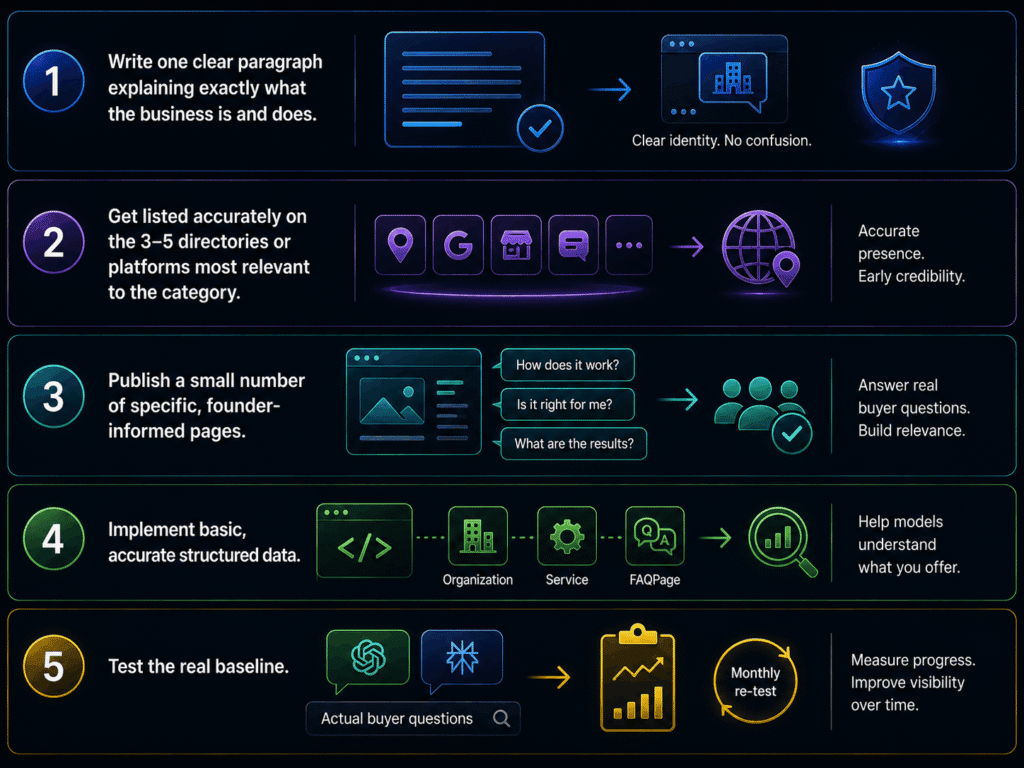
- Write one clear paragraph explaining exactly what the business is and does. Make it specific enough that a model couldn’t accidentally describe a competitor when repeating it.
- Get listed accurately on the 3–5 directories or platforms most relevant to the category. Do this before worrying about a large content calendar.
- Publish a small number of specific, founder-informed pages. Focus on the questions buyers actually ask instead of producing large volumes of generic category content.
- Implement basic, accurate structured data. Apply it across the core pages that genuinely need it.
- Test the real baseline. Use actual buyer questions in ChatGPT and Perplexity, then repeat the test monthly as your content and off-site presence grow.
How TechRix Solutions Approaches GEO for Startups
TechRix Solutions doesn’t take an enterprise content calendar and simply make it smaller.
The process starts with the same audit-first approach used across engagements, but the sequence reflects what a startup actually has and lacks: clear entity positioning, a focused set of specific content, and early off-site presence.
Volume comes later.
Full details on how GEO works alongside AEO are available on the AI SEO services page.
Frequently Asked Questions
Is GEO worth investing in before a startup has product-market fit?
It depends on the startup’s stage.
A company still validating its core offering will usually get more value from clarity work, particularly defining the entity precisely, than from launching a full content and off-site campaign. The underlying positioning may still change significantly.
How is GEO for startups different from GEO for an established business?
An established business typically restructures existing content and fixes inconsistencies across existing off-site sources.
A startup builds both from a genuine blank slate. That shifts the sequence toward entity clarity and early off-site presence before a large-scale content audit becomes useful.
Can a startup do GEO without a large content budget?
Yes.
A small set of specific, clear pages combined with accurate early off-site listings can outperform a much larger collection of generic content. Neither approach requires enterprise-level spending.
Should a startup prioritize SEO or GEO first?
Neither replaces the other.
A technically sound, indexable website remains the foundation GEO depends on. Most startups should establish basic SEO fundamentals before expecting GEO-specific content restructuring to produce a measurable return.
How soon should a startup start testing its AI citation baseline?
As soon as the core positioning and a handful of priority pages exist.
Testing early gives you the baseline against which every later GEO investment gets measured, even when those starting numbers are low.
See Where Your Startup Actually Stands With AI Search
Most growth-stage startups have never checked whether ChatGPT or Perplexity even recognize their business.
A free AI visibility audit from TechRix Solutions tests your real buyer questions and shows exactly where your startup should start.