
SEO gets people to your site. SXO helps turn them into customers.
That distinction sounds simple but startups often treat SEO and SXO as if they solve the same problem. They don’t.
SEO helps a page get discovered and rank in search results. SXO focuses on what happens after someone clicks: whether they find what they expected, understand the offer, and take the next step.
A startup can build strong organic traffic through SEO and still struggle with signups, leads, or sales. When that happens, more rankings may not fix the real problem. The page experience might.
This guide explains the practical difference between SXO vs SEO, why the gap matters so much for startups, and how to identify which problem your website actually has.
What Is SEO, Briefly?
Search engine optimization improves a website’s technical health, on-page relevance and off-page authority so it can rank higher in organic search results.
SEO focuses heavily on visibility. Its core results include keyword rankings, organic traffic and backlink strength.
In simple terms, SEO helps answer one question:
Can people find your page when they search?
What Is SXO, Briefly?
Search Experience Optimization combines ranking work with the experience visitors have after they click.
It asks a different set of questions. Can visitors quickly find what they need? Does the page match what they expected from the search result? Can they understand the offer without working for it? Do they know what to do next?
The full definition and mechanics appear in What Is SXO?.
The short version: SXO connects the search journey with the on-page experience instead of treating the click as the finish line for SEO.
SXO vs SEO: The Core Differences
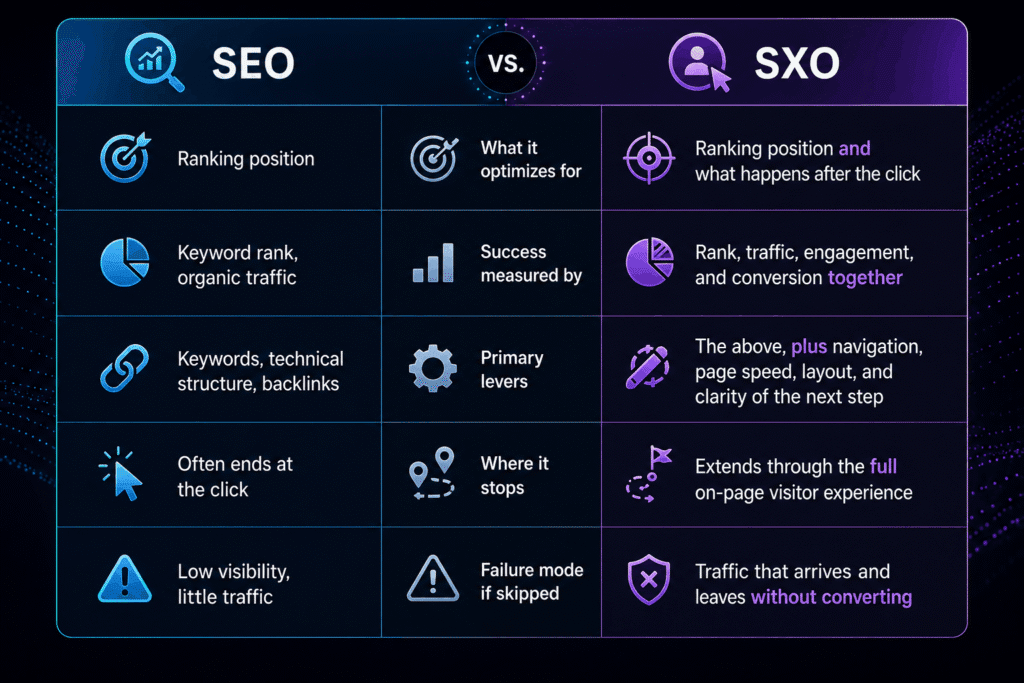
The simplest way to understand SXO vs SEO is to look at the customer journey.
SEO helps someone discover you.
SXO helps that person get value from the visit.
You need both if organic search should contribute to business growth.
Why Startups Specifically Can’t Skip SXO
A startup investing in SEO early makes a necessary investment. But every visitor matters more when the business has limited traffic compared with an established competitor.
That makes wasted traffic expensive.
Imagine spending months building rankings, earning organic clicks, and finally getting consistent visitors to a product page. If that page loads slowly, confuses visitors, or hides the next step, the SEO work can generate traffic without generating enough business.
The SEO for Startups playbook covers the ranking foundation. SXO determines whether that foundation produces signups, leads or sales once visitors arrive.
There’s another reason this matters more now.
As AI Overviews and generative answers absorb more purely informational queries, the people who still click through to websites can represent stronger buying intent. A confusing or slow page can waste exactly the visitors most likely to take action.
Signs Your Problem Is SXO, Not SEO
Your rankings may not be the problem.
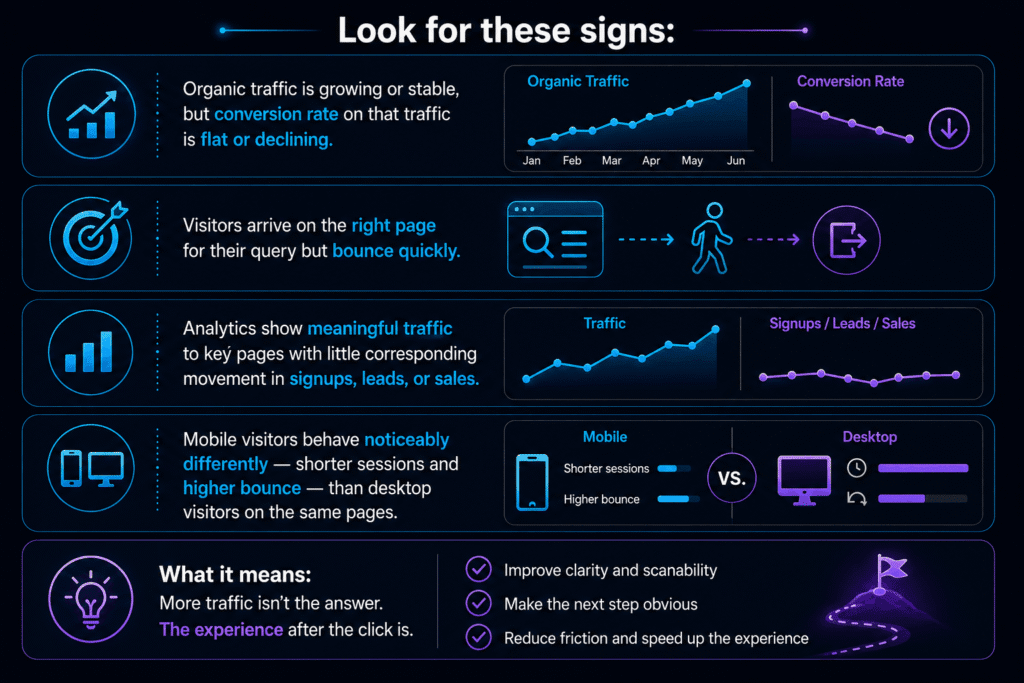
In this situation, getting more traffic may simply give you more visitors who leave.
The better question becomes: What happens after they arrive?
Signs Your Problem Is SEO, Not SXO
Sometimes the page experience works fine. The website simply doesn’t get enough qualified organic traffic.
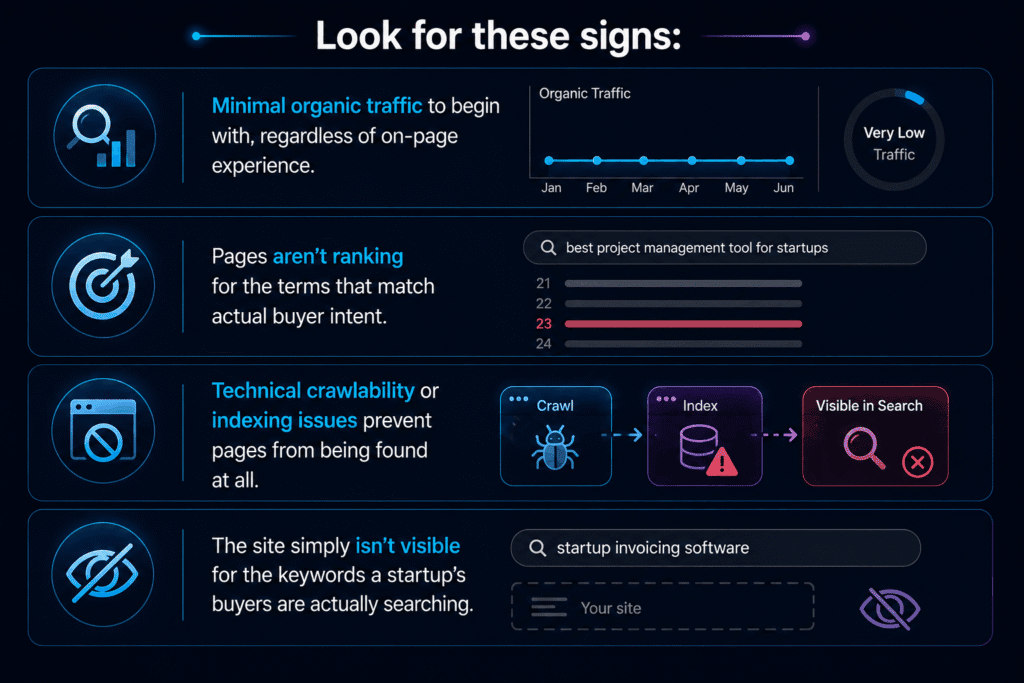
Here, improving the page experience won’t solve the main problem. You first need to make the page discoverable for the right searches.
What This Looks Like on an Actual Startup Page
Take a startup’s core product page that ranks reasonably well for its target keyword.
An SEO-only review might check the keyword targeting, title tag, and backlinks pointing to the page. Once those elements look good, the work may appear complete.
SXO asks what happens next.
Does the page load quickly on mobile, where a meaningful share of the traffic likely arrives? Does it clearly explain near the top what the product does and who it’s for? Or does the visitor have to scroll, read several sections, and figure it out alone?
Then look at the call to action.
Does the page give visitors one clear next step, such as signing up or requesting a demo? Or does it present several competing options that split attention?
Two startups can rank identically for the same term and still generate very different conversion rates because their on-page experiences differ.
That’s the practical difference between search experience optimization vs SEO.
How to Run SEO and SXO as One System
Don’t separate ranking work from page-experience work.
When teams treat them as unrelated projects, they can end up with pages that rank well but convert poorly. Nobody owns the entire journey from search result to conversion.
A better approach connects both from the beginning.
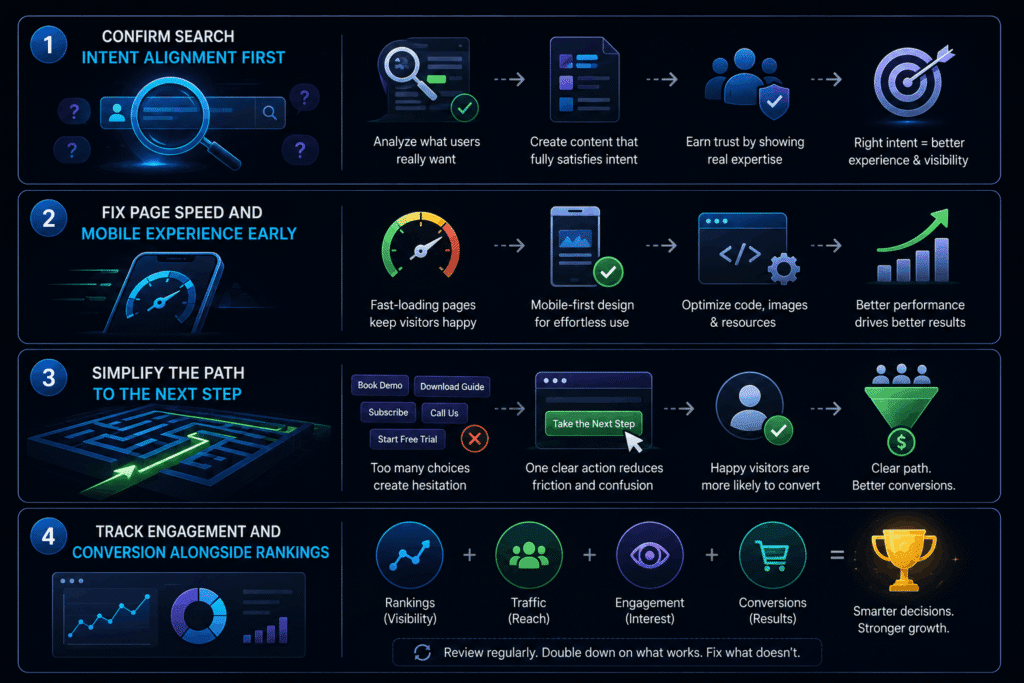
1. Confirm Search Intent Alignment First
Before optimizing anything else, make sure the page answers the searcher’s actual question.
A page can technically target a keyword and still miss the reason someone searched for it. When that happens, the page creates a poor experience no matter how well it ranks.
2. Fix Page Speed and Mobile Experience Early
Page speed and mobile experience affect a broad share of visitors, so they deserve attention early.
A visitor shouldn’t have to wait for the page to become usable or struggle to navigate it on a phone.
3. Simplify the Path to the Next Step
Give visitors a clear action.
A page that asks someone to book a demo, download a guide, subscribe to a newsletter, call the business, and start a free trial at the same time can create unnecessary friction.
One clear call to action often works better than several competing options.
4. Track Engagement and Conversion Alongside Rankings
Don’t judge an SEO campaign only by ranking position.
Track organic traffic, engagement, and conversion together. That way, you can identify a page that succeeds at SEO but struggles with SXO before the problem grows.
How TechRix Solutions Approaches SXO vs SEO
TechRix Solutions treats the page-experience layer as part of the ranking work covered under SEO and AI SEO.
The goal isn’t simply to earn the click. The goal is to make that click produce a measurable business outcome after the visitor arrives.
You can see the full service detail on the SXO services page.
Frequently Asked Questions
Is SXO just a rebrand of conversion rate optimization?
Not exactly.
CRO usually focuses on improving the conversion path on a page. SXO connects that work to the search journey.
That means SXO considers what visitors expected from the query that brought them to the page, whether the page delivers on that expectation, and how naturally it moves them toward conversion.
How do I know if I have an SXO problem instead of an SEO problem?
If a page ranks and earns meaningful organic traffic but fails to convert visitors or hold their attention, you likely have an SXO gap.
Your ranking work is doing its job. The page experience isn’t getting enough value from the traffic it earns.
Does fixing SXO issues help SEO rankings too?
Often, indirectly.
Engagement signals such as bounce rate, time on page, and return visits can help indicate whether visitors find a page useful over time. Improving the experience can therefore support SEO performance, even though rankings aren’t the primary goal of SXO.
Should a brand-new startup worry about SXO before it has meaningful traffic?
Yes, at least for the fundamentals.
Page speed, mobile experience, and a clear single call to action make sense from the beginning, regardless of traffic volume. Fixing these elements early usually costs less than rebuilding a site later around a flawed structure.
What’s the fastest SXO fix for a startup with limited resources?
Start with page speed and mobile experience.
These changes can affect a large share of visitors quickly, before you even start making broader content or layout changes.
Find Out Whether Your Traffic Is Actually Converting
Ranking well and converting well are different problems.
Most startups diagnose the first one and overlook the second.
A free AI visibility audit from TechRix Solutions looks at both sides of that gap.