AEO and SEO solve different visibility problems.
Treating them as competing strategies misses the point. SEO helps a page rank in a traditional list of search results. AEO helps a business become the direct answer when a search engine, voice assistant, or AI tool needs to surface one source instead of giving the searcher ten links to evaluate.
So the real question isn’t which one wins. It’s which visibility gap matters more for a specific business right now, and which discipline should come next.
This guide explains what each discipline optimizes for, where they overlap, where they genuinely differ, and how to decide which one to prioritize when time or budget forces you to sequence them.
What Is SEO, In One Sentence?
Search engine optimization improves a website’s technical health, on-page relevance, and off-page authority so it can rank higher on a traditional search results page, the list of links a search engine returns for a query. Success typically comes down to keyword position, organic traffic, and the strength of the site’s backlink profile.
What Is AEO, In One Sentence?
Answer Engine Optimization structures content so an engine can select it as the single direct answer to a specific question, whether that appears as a featured snippet, a voice assistant’s spoken response, or the lead line of an AI Overview. Instead of becoming one link among several, the goal is to become the answer the searcher sees or hears first. The full definition and mechanics are covered in What Is AEO?.
AEO vs SEO: The Core Differences
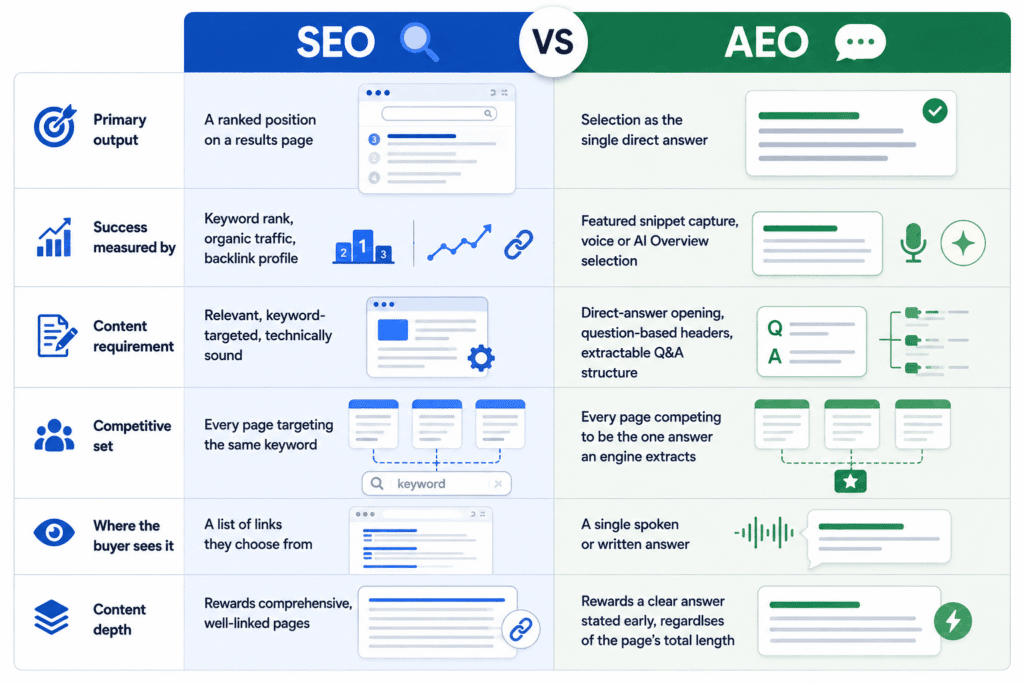
Where AEO and SEO Overlap
The overlap is much bigger than the “vs” framing suggests. That’s exactly why AEO doesn’t replace SEO fundamentals.
Both disciplines depend on technical crawlability, clean indexing, and topical authority. An answer engine still needs to find and trust a page before it can consider extracting an answer from it. A beautifully structured, question-first page won’t get featured if the site loads slowly, has indexing problems, or gives search engines little reason to trust it.
Content quality matters to both, too, although each discipline emphasizes different aspects of it. SEO rewards relevance and depth. AEO puts more emphasis on content that gives an engine a direct, accurate answer it can extract cleanly.
That explains why strong AEO content often makes strong SEO content as well. In many cases, you don’t need to rewrite the page from scratch. You need to restructure it so the answers become easier to identify and extract.
Where AEO and SEO Diverge
AEO places stricter demands on content structure.
A page can rank on page one of Google while hiding its actual answer beneath three paragraphs of context. Traditional search can tolerate that pattern. The page can still rank because the searcher can read through the content and find what they need.
A featured-answer system has a different job. It needs to identify a concise answer quickly, so content that states the answer immediately has a stronger chance of getting selected.
The signals also carry different relative weight. Backlinks play a more direct role in SEO’s ranking calculation, while question-header matching and answer clarity play a more direct role in AEO’s selection process.
Neither discipline completely ignores the other’s signals. The difference comes from how heavily each signal matters. Optimize exclusively for one, and you can leave meaningful visibility opportunities on the table.
AEO or SEO First? How to Decide
The right sequence depends on where the business stands today. There isn’t one rule that applies to every site.
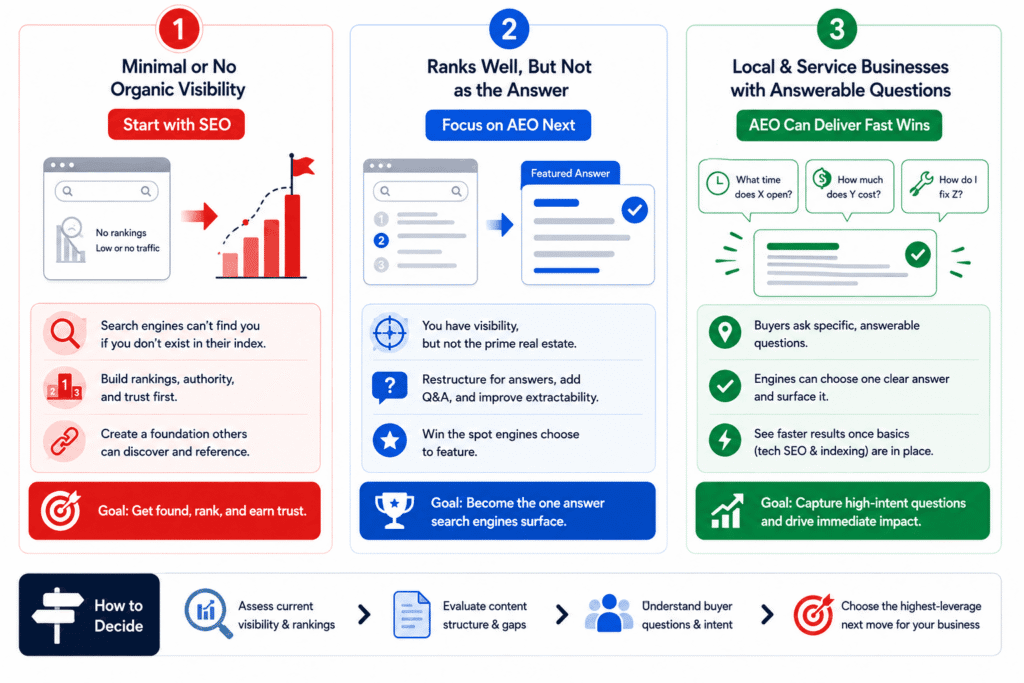
- If a business has minimal or no organic visibility yet, SEO comes first. There’s no useful answer to extract from a page that search engines can’t find, rank, or trust in the first place.
- If a business already ranks reasonably well but its buyers’ direct questions never surface its content as a featured answer, AEO becomes the higher-leverage next move. The foundation exists; the content structure represents the gap.
- Local and service businesses whose buyers ask specific, answerable questions such as “what time does X open,” “how much does Y cost,” or “how do I fix Z” can often see faster AEO returns once basic technical SEO and indexing are in place. These queries often have one clear answer that an engine can select.
Signs a Business Needs AEO Specifically
- It already ranks on page one for core terms but never appears in the featured snippet box or an AI Overview’s lead line.
- Buyers in the category ask direct, answerable questions rather than open-ended comparison queries.
- Existing content is accurate but buries the actual answer beneath paragraphs of general context before stating it plainly.
Signs a Business Needs SEO Specifically
- It has little to no organic visibility for core service or product terms.
- It has unresolved technical issues such as slow load times, poor mobile experience, or indexing gaps.
- It has no meaningful backlink profile or established topical authority in the category yet.
Why Most Businesses Eventually Need Both
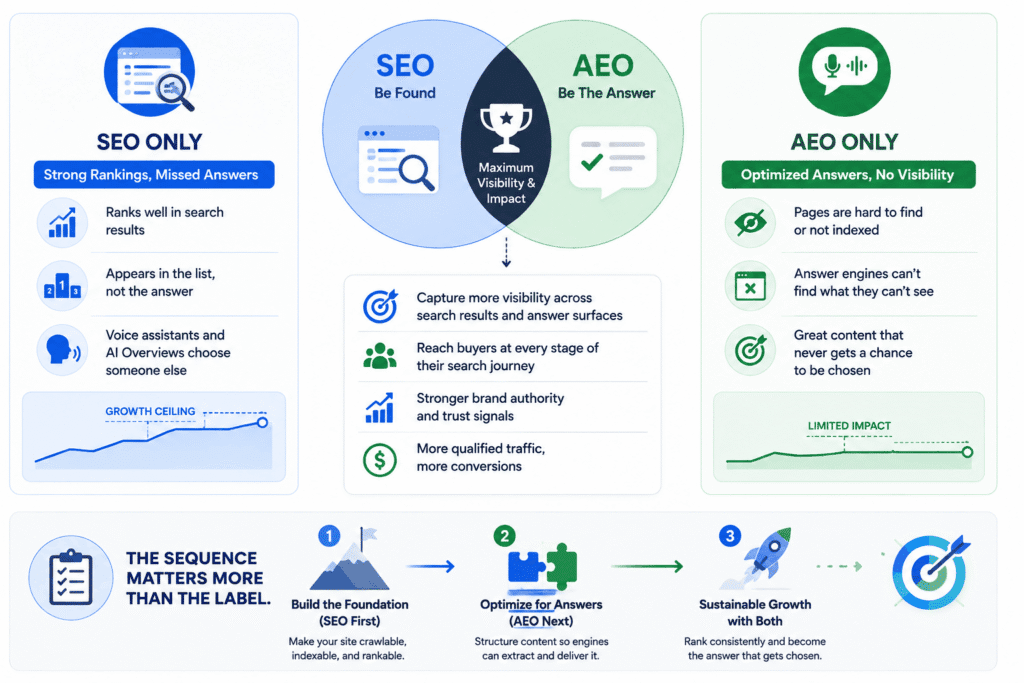
A business that builds an SEO foundation and stops there can hit a real ceiling. It may rank consistently while still missing opportunities to become the answer a voice assistant reads aloud or an AI Overview places first.
The opposite creates a similar problem. A business that jumps straight into AEO-style content restructuring on a technically weak, unranked site may spend time optimizing pages that an answer engine has little chance of finding.
The sequence matters more than the label.
It’s the same basic argument covered in GEO vs SEO. GEO and AEO follow nearly the same underlying logic, but they target different query types. Ignoring either discipline completely can leave a real, measurable visibility gap rather than a hypothetical one.
How TechRix Solutions Approaches AEO vs SEO
TechRix Solutions doesn’t treat AEO and SEO as competing line items fighting for the same budget.
Every engagement starts with an audit that shows where a business’s ranking foundation stands and where its answer-engine selection rate stands today. From there, the sequencing decision comes from the actual gap rather than a default assumption about which discipline sounds more current.
Full details on how the two work together are available on the AI SEO services page.
Frequently Asked Questions
Is AEO more important than SEO now?
Neither replaces the other. The priority depends on where a specific business stands.
A business with no organic visibility needs SEO first. A business that already ranks but never gets selected as a direct answer needs AEO next.
Can I do AEO without doing SEO first?
Not effectively.
An answer engine still needs to find, crawl, and trust a page before it can consider extracting an answer from it. Basic SEO fundamentals therefore remain a prerequisite, not an alternative.
How long does it take to see AEO results?
Content structured around direct answers can start appearing in featured snippets or AI Overview lines within weeks because the changes primarily improve extractability from pages an engine can already find.
Businesses building SEO and AEO together from a low starting point should expect a longer, multi-month timeline.
Does Google’s algorithm treat AEO and SEO as separate ranking factors?
Not as two officially labeled systems.
In practice, though, featured snippet selection and traditional ranking rely on different signals. That’s why a page can rank well without getting featured, or, on rare occasions, get featured without holding the strongest traditional ranking position.
What’s the fastest way to tell if my business needs AEO right now?
Start with your highest-priority pages. Check whether they already rank reasonably well, then search the exact questions your buyers ask.
If your business’s content ranks but never appears as the featured snippet or AI Overview line, you’ve likely found an AEO gap.
Find Out Which Gap Your Business Actually Has
Guessing between AEO and SEO can waste budget on the wrong problem.
A free AI visibility audit from TechRix Solutions shows where your ranking foundation and answer-engine selection rate currently stand. That gives you a clear starting point for deciding what to fix first.