Start with the baseline, not the backlinks.
A real LLM citation strategy follows a deliberate sequence of on-site and off-site work. It starts with a cross-platform baseline and builds from there. One blog post, one directory listing or a vague goal to “show up more on ChatGPT” won’t give you a strategy.
The order matters.
If you start building off-site corroboration before you define what the business should get cited for, you risk reinforcing vague or inconsistent information. And if you track citation frequency without a baseline, you have no reliable way to tell whether your work actually improved visibility.
This guide lays out that sequence for a business starting from zero. It isn’t a collection of disconnected tactics. Each step creates the foundation for the next.
What “From Scratch” Actually Means Here
Most LLM citation advice assumes the business already has some foundation. Maybe it has a functioning website, existing content, several directory profiles, or some idea of how it appears across AI platforms.
Starting from scratch means that foundation either doesn’t exist or remains too scattered and inconsistent to support a real strategy.
That changes where you begin.
First, you need to define the business as an entity and establish the core claims you want independent sources to reinforce. Everything else builds around those two things.
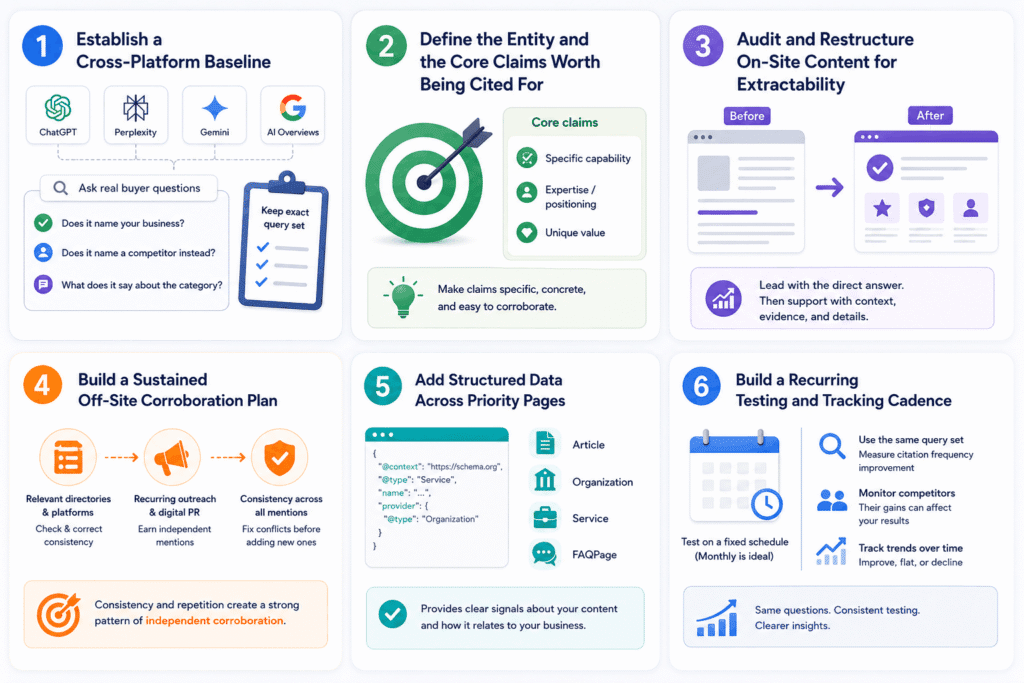
Step 1: Establish a Cross-Platform Baseline
Before you build anything, find out where the business stands today.
Test the business across ChatGPT, Perplexity, Gemini, and Google’s AI Overviews. Use the questions real buyers would ask. Don’t search only for the brand name. Test the actual problem, service, product, or category query a stranger might type or speak.
Record three things:
- Does the model name the business?
- Does it name a competitor instead?
- What does the response say about the category generally?
Keep the exact query set.
That baseline becomes your reference point for every later test. Without it, you can make changes, see different results, and still have no reliable way to determine whether your strategy produced the improvement.
Step 2: Define the Entity and the Core Claims Worth Being Cited For
Now answer the most important question: What exactly do we want this business to become known and cited for?
Write down the specific claims, capabilities, expertise, or positioning you want an AI model to associate with the business.
Don’t settle for a generic marketing description.
For example, “we provide high-quality SEO services” gives independent sources very little specific information to reinforce. A precise claim gives them something concrete to corroborate.
The goal isn’t to create language that sounds impressive. The goal is to define statements that a model could accurately attribute to the business and repeat because multiple sources support them.
Vague positioning creates vague corroboration. Specific claims give the entire strategy something concrete to build around.
Step 3: Audit and Restructure On-Site Content for Extractability
Next, examine the pages that matter most.
Start with service pages, the About page, and any other pages that already attract meaningful traffic. Compare their content against the core claims you defined in Step 2.
Ask a simple question: Can someone quickly find the specific answer, or does the page bury it beneath generic company information?
If the page needs five paragraphs before it explains what the business actually does, restructure it.
Lead with the direct answer. State the specific capability, positioning, or claim clearly and early. Then support it with the necessary context, evidence, examples, and details.
This work gives you the on-site side of the citation strategy. It also tends to move faster than off-site work because your team controls the website directly.
Step 4: Build a Sustained Off-Site Corroboration Plan
This is where many from-scratch strategies fall short.
Businesses often create a few directory profiles, publish some content, and stop. That approach rarely closes a meaningful citation gap because one isolated mention doesn’t create a strong pattern of independent corroboration.
You need a recurring plan.
The goal is to get the Step 2 claims echoed accurately and consistently across independent sources that make sense for the business. Depending on the category, those sources might include relevant industry directories, review platforms, comparison content, and publications that cover the industry.
Think in terms of consistency and repetition, not a one-time campaign.
A practical plan usually includes:
- A defined list of the directories and platforms most relevant to the specific category, checked and corrected for consistency
- A recurring outreach or digital PR cadence aimed at earning independent mentions, not just internal content
- A consistency check across every place the business already appears, correcting conflicting descriptions or claims before adding new ones
The objective isn’t to collect as many mentions as possible. It is to create a consistent body of independent information that supports the claims you want models to associate with the business.
Step 5: Add Structured Data Across Priority Pages
Once the priority pages carry your core claims clearly, add structured data where it genuinely applies.
Implement Article, Organization, Service, and FAQPage schema across the pages carrying the Step 2 core claims.
Structured data doesn’t replace strong content or off-site corroboration. It supports them.
It gives retrieval-based systems clearer signals about what a page represents and how its information relates to the business, rather than forcing the system to infer everything from unstructured page content.
It also makes a relatively low-cost, one-time technical improvement compared with the ongoing work required for off-site corroboration in Step 4.
Step 6: Build a Recurring Testing and Tracking Cadence
Without measurement, a citation strategy becomes a collection of assumptions.
Return to the Step 1 baseline on a fixed schedule. Monthly makes sense for most businesses. Use the same query set each time and record whether citation frequency improves, stays flat, or declines.
Keep an eye on competitors, too. They may improve their own visibility while you work, which can change the results even if your business makes progress.
Unlike traditional SEO, LLM citation work doesn’t have a standardized analytics dashboard that works like keyword rank tracking. That makes recurring manual testing especially important.
The same questions, tested consistently over time, give you the clearest available signal about whether the strategy actually works.
What a Real LLM Citation Strategy Document Should Include
A useful strategy document should tell the team what happened, what needs to change, and what happens next.
It typically includes:

That document gives everyone one source of truth. It also makes it much easier to identify where progress stalls.
Who Should Own This Inside a Small Team
Give one person responsibility for the entire sequence.
That person should own the baseline test, entity definition, content audit and off-site corroboration plan. When different people handle each part without one person maintaining the complete picture, inconsistencies tend to appear.
For example, one team might rewrite the website around a specific claim while another team creates directory profiles using different positioning. The result creates conflicting signals instead of reinforcing the same entity and claims.
A single owner keeps the definition from Step 2 consistent throughout every later stage.
The business doesn’t need a large team. It needs clear ownership.
How This Differs From a One-Time Content Push
A common shortcut looks like this: create one blog post or landing page designed specifically to “address AI visibility,” publish it, and move on.
That isn’t a citation strategy.
At best, it creates one additional data point. A model has little reason to treat that page as meaningful simply because the business created it. The claims need support from other sources, and the page needs ongoing maintenance as the business and its information change.
The strategy in this guide keeps moving after publication.
The sustained off-site corroboration plan builds external support, while the recurring testing cadence tells you whether that work changes citation frequency. Those two components separate a genuine strategy from a single piece of content dressed up as one.
Common Reasons Citation Strategies Fail
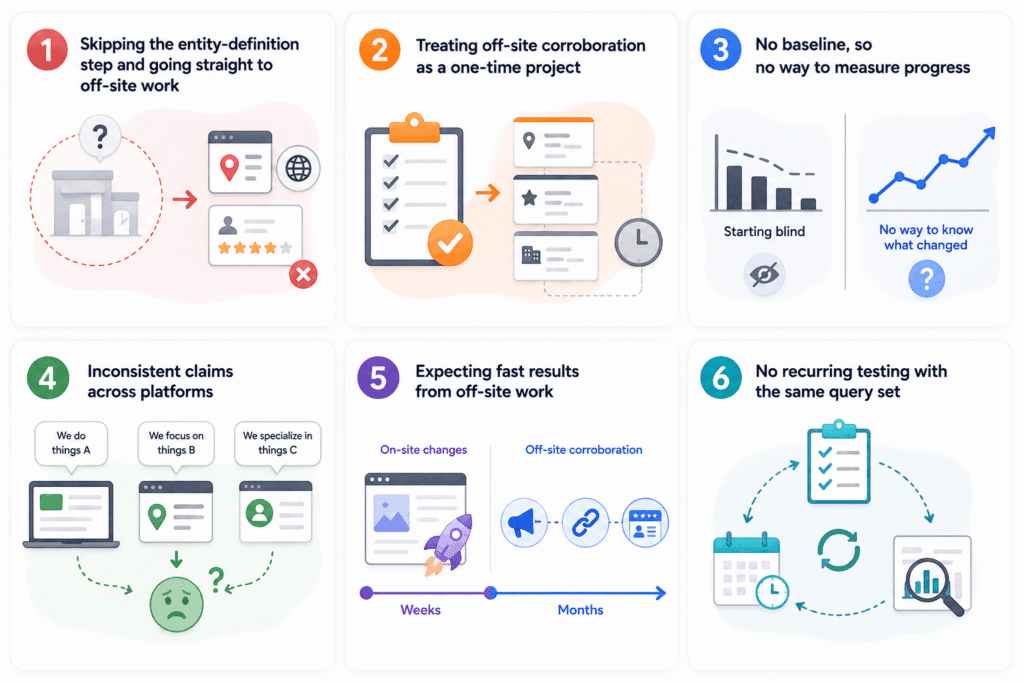
- Skipping the entity-definition step and going straight to off-site work. If the business hasn’t defined a specific positioning or set of claims, independent sources have nothing concrete to reinforce. Generic corroboration rarely produces useful citations.
- Treating off-site corroboration as a one-time project. A handful of directory listings completed once and then ignored rarely shifts a citation gap on their own. Businesses need ongoing corroboration.
- No baseline, so no way to measure progress. Without the Step 1 test, later tests have nothing reliable to compare against. The strategy can’t demonstrate whether it produced an improvement.
- Inconsistent claims across platforms. If the business describes itself differently on its website, directory listings, and social presence, models encounter conflicting information instead of a consistent, corroborated signal. That directly undermines the strategy.
- Expecting fast results from off-site work specifically. On-site restructuring can show up in re-tests within weeks. Off-site corroboration typically takes months to compound. Treating it like a quick fix often causes businesses to abandon the work before it has time to produce results.
How TechRix Solutions Builds LLM Citation Strategy
TechRix Solutions follows this exact sequence: baseline testing, entity definition, content audit, sustained off-site corroboration, and recurring re-testing.
The work forms part of the broader LLM Citations services engagement rather than a collection of isolated tactics pulled from different sources.
The strategy also keeps clear ownership from start to finish. TechRix Solutions doesn’t hand the plan off after a single kickoff call and leave the client to connect the pieces.
Frequently Asked Questions
How long does it take to build a full LLM citation strategy from scratch?
The on-site content audit and restructuring can typically take a few weeks.
The off-site corroboration plan takes longer to produce meaningful results because independent mentions compound over time. In most cases, a complete strategy with measurable citation improvement represents a multi-month project rather than a one-time deliverable.
What’s the single most important step for a business starting from zero?
Define the entity and its core claims before starting any off-site work.
If you try to corroborate vague or generic positioning, you waste the off-site effort because independent sources have nothing specific to echo consistently.
Do I need a different strategy for ChatGPT versus Perplexity versus Google AI Overviews?
The core strategy remains largely the same: establish entity clarity, restructure content, build off-site corroboration, and use structured data where appropriate.
Platform-specific factors still matter at the margins. We cover those separately in How to Get Cited by ChatGPT and How to Get Cited by Perplexity.
Can a small business build this without outside help?
Yes, for some parts.
An internal team can handle the on-site content audit and restructuring if it has the necessary skills and time. The off-site corroboration plan and recurring cross-platform testing usually create more difficulty because they require sustained effort rather than one concentrated push.
How do I know if the strategy is actually working?
Run the baseline test again.
If citation frequency across the same query set improves across successive tests, you have evidence that the strategy is working. If results remain flat or decline, revisit the content and corroboration plan to identify where the strategy needs adjustment.
Start With a Real Baseline, Not a Guess
Every strategy in this guide starts with one thing: knowing exactly where the business stands today.
A free AI visibility audit from TechRix Solutions runs that baseline test across the platforms your buyers actually use.