AI Overviews reward clarity, credibility, and strong SEO foundations.
Getting into a Google AI Overview depends on the same content clarity and source credibility that can earn citations in ChatGPT or Perplexity. But first, Google needs to find and trust the page through solid technical SEO.
AI Overviews appear above traditional organic results and combine information from multiple sources before a searcher reaches the first blue link. That creates an important distinction: a business can rank well in organic search and still miss the exact section most searchers read first.
This guide breaks down what actually helps a page appear there, step by step. It focuses on the practical work rather than repeating general SEO advice with “AI” added to it.
What Are Google AI Overviews?
Google AI Overviews are AI-generated summaries that appear above traditional organic search results. They combine information from several sources, then name a small number of those sources directly.
They work somewhat like featured snippets because both formats provide direct answers. The difference is that featured snippets generally extract a passage from one source, while AI Overviews generate a synthesized response using information from multiple sources.
For the searcher, an AI Overview can answer the query without requiring a click.
For a business, that changes what visibility means. Ranking on page one still matters, but appearing inside the Overview can put the business directly in front of the searcher before they reach the traditional results.
How Google AI Overviews Decide What to Feature
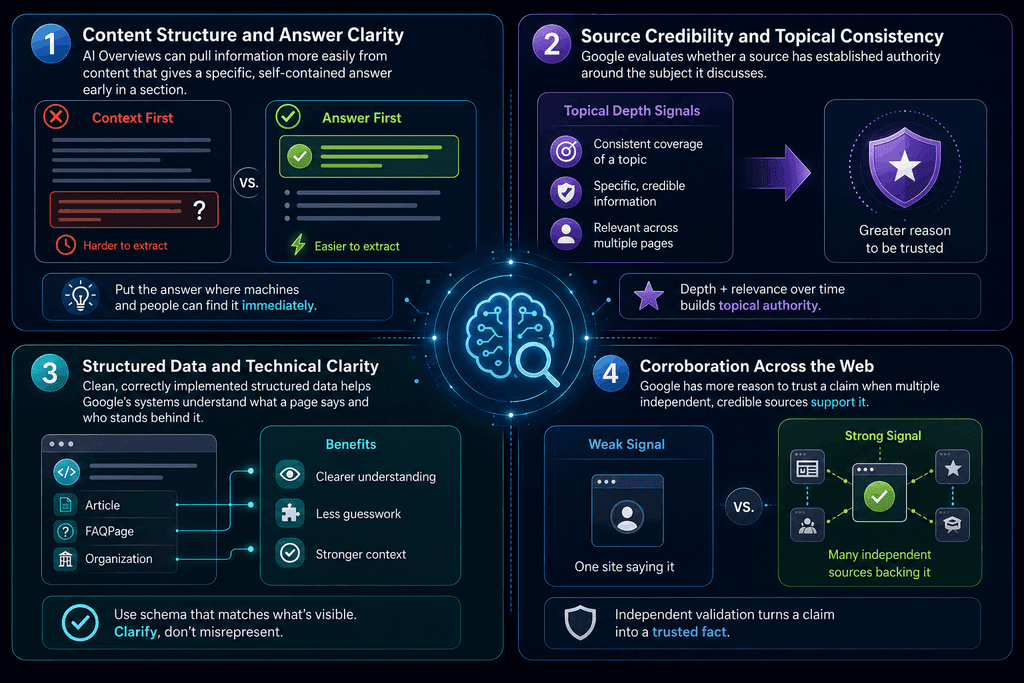
Content Structure and Answer Clarity
AI Overviews can pull information more easily from content that gives a specific, self-contained answer early in a section.
Think about the difference between these two approaches. One page spends several paragraphs building context before answering the question. Another starts the section with a clear, direct answer and then explains the reasoning underneath.
The second structure gives Google’s systems a cleaner piece of information to work with.
A page doesn’t need to eliminate context or depth. It needs to make the actual answer easy to find.
Source Credibility and Topical Consistency
Google evaluates whether a source has established authority around the subject it discusses. A site that consistently publishes specific, credible information about a topic gives Google’s systems more reason to trust it than a single relevant page on an otherwise unrelated domain.
This overlaps with the credibility principles discussed in What Is GEO?. AI Overviews and generative engines such as ChatGPT and Perplexity use many of the same underlying signals when deciding which sources deserve consideration.
Structured Data and Technical Clarity
Clean, correctly implemented structured data helps Google’s systems understand what a page says and who stands behind it.
Article, FAQPage, and Organization schema can provide useful context when they genuinely apply to the visible content. They don’t replace good writing, but they reduce the amount of information Google has to infer from the page.
That distinction matters. Schema should clarify the page, not describe content that visitors can’t actually see.
Corroboration Across the Web
Google has more reason to trust a claim when multiple independent, credible sources support it.
A business making a claim only on its own website gives an AI system less evidence to work with. The same claim appearing accurately across industry publications, review platforms, and other trusted sources gives that claim more external support.
The same principle applies to LLM citation strategy generally: independently supported information provides a stronger foundation for a generated answer than an isolated claim.
Step-by-Step: How to Optimize for Google AI Overviews
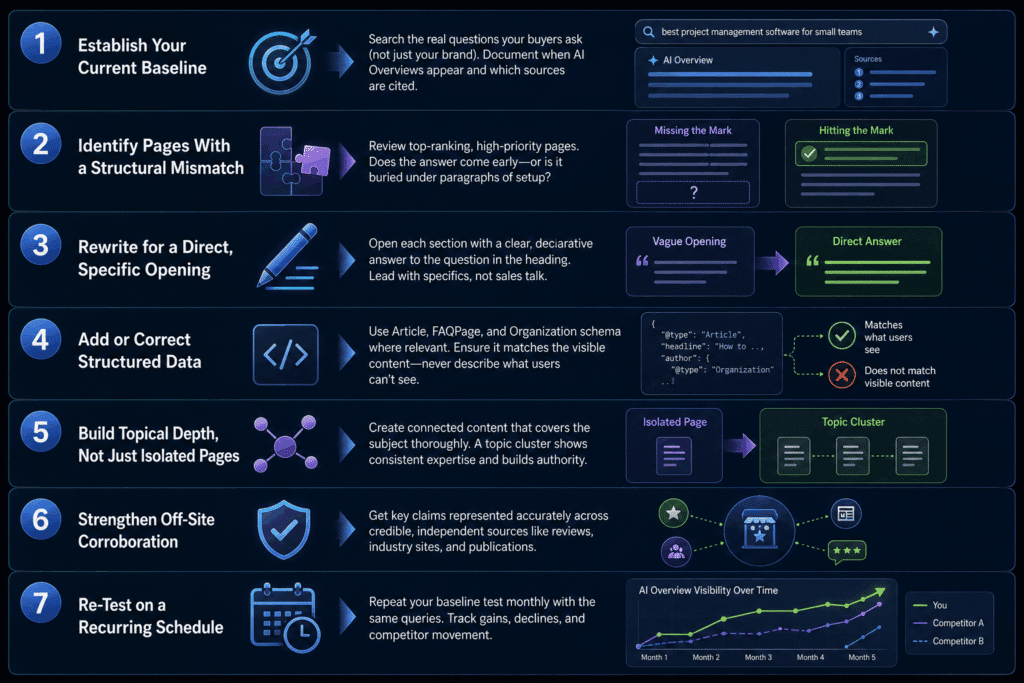
Step 1: Establish Your Current Baseline
Start with the exact questions your buyers search for.
Don’t search only for your brand name. Search the actual questions that matter to the business, then record whether an AI Overview appears and which sources it names.
Run this test across your highest-priority keyword targets before making changes. That baseline gives you something concrete to compare against later.
Step 2: Identify Pages With a Structural Mismatch
Review your top-ranking and highest-priority pages.
Ask one simple question: does the page answer the query clearly within the first sentence or two of the relevant section, or does it spend several paragraphs setting up the answer?
A page can rank well while answering late. That structural mismatch often creates an opportunity for AI Overview optimization.
Step 3: Rewrite for a Direct, Specific Opening
Restructure the relevant sections so each one starts with a clear, declarative answer to the question in its heading.
Avoid vague promotional introductions. They give an AI Overview little useful information to extract.
A specific, accurate statement gives Google’s system a concrete piece of information it can use when building the summary.
Step 4: Add or Correct Structured Data
Implement Article, FAQPage, and Organization schema where they genuinely apply.
Then make sure the schema accurately represents the visible content on the page. Don’t use structured data to describe information that doesn’t appear to users.
Incorrect or inflated schema can undermine trust rather than improve it.
Step 5: Build Topical Depth, Not Just Isolated Pages
One strong page has a harder job when it competes against a site with sustained authority around the same subject.
Build connected content around the topic instead of publishing isolated pages whenever a keyword appears on your content calendar. A coherent topic cluster gives Google’s systems more evidence that the site understands the subject consistently.
Step 6: Strengthen Off-Site Corroboration
Get the business’s important claims accurately represented across credible third-party sources.
That can include review platforms, industry publications, and other relevant websites. When information appears consistently across independent sources, an AI system has more evidence supporting the claim than it would from the business’s website alone.
Step 7: Re-Test on a Recurring Schedule
Repeat the Step 1 baseline test every month using the same query set.
Track whether the business starts appearing in AI Overviews, stays at the same level, or loses visibility while competitors make their own improvements.
There isn’t a standard dashboard for this yet. Direct, repeated testing gives you the most practical way to measure progress.
What to Do If a Competitor Is Already Appearing Instead of You
A competitor appearing in an AI Overview for a query your business should reasonably win gives you a useful comparison point.
Start with the competitor’s page. Look at how it answers the relevant question. Does it give the answer within the first sentence or two? Does it use structured data that your page lacks? Does it provide stronger topical coverage or external corroboration?
Focus on the specific gap rather than trying to beat the competitor on general authority alone. AI Overview selection responds to the content pattern as well as the authority of the domain behind it.
Common Mistakes That Keep Pages Out of AI Overviews
- Answering the right question too late. A page can eventually provide the correct answer, but several paragraphs of setup make that answer harder for an extraction system to identify.
- Treating schema as a checkbox. Structured data should accurately describe the page. If it exaggerates or misrepresents the content, it can hurt the trust it should support.
- Publishing isolated pages instead of building topical depth. One strong page on an otherwise thin site often struggles against a site with sustained, connected authority around the same subject.
- Ignoring off-site corroboration. A claim that exists only on the business’s website has less independent support than one backed by credible third-party sources.
- Ignoring the actual query. Optimizing for a short keyword phrase instead of the full question a buyer asks can disconnect the content from the searcher’s intent.
AI Overviews vs. Featured Snippets: What’s Different?
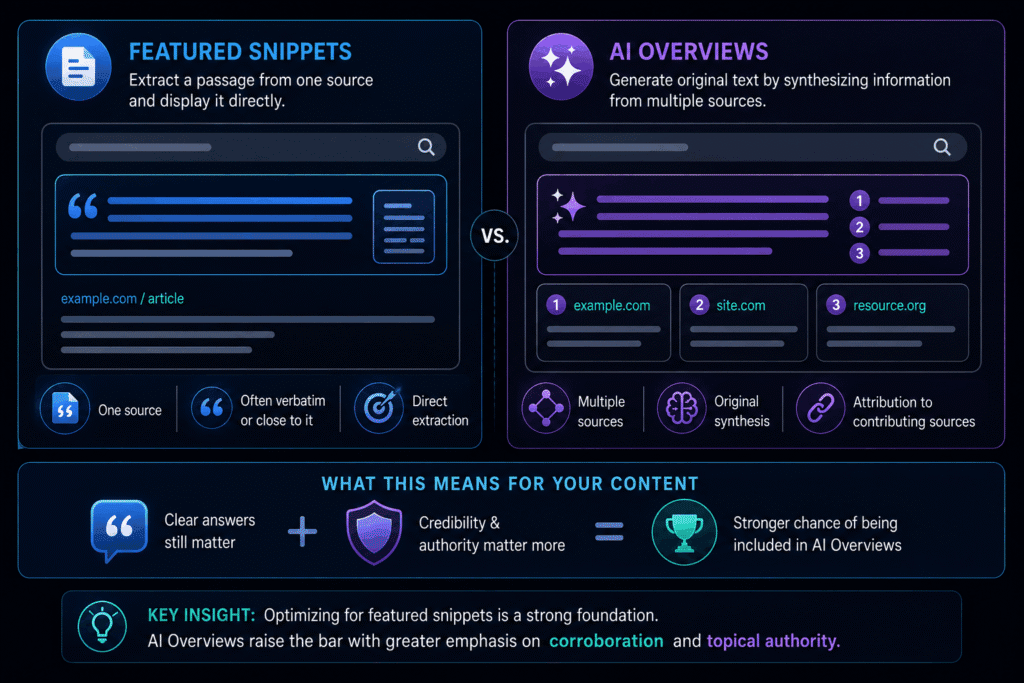
Featured snippets generally extract a passage from one source and display it directly, often verbatim or close to it.
AI Overviews work differently. They generate original text by synthesizing information from multiple sources and then identify several sources that contributed to the response.
That means clear answers still matter, but clarity alone isn’t the whole requirement. A page needs to provide a clear answer and enough credibility for Google to consider it a reliable source within the broader synthesis.
Optimizing for featured snippets gives a page a strong starting point for AI Overview visibility. AI Overviews, however, add greater emphasis on corroboration and topical authority.
How TechRix Solutions Approaches AI Overview Optimization
TechRix Solutions starts AI Overview work with baseline testing.
Before restructuring anything, the team checks what currently appears for a business’s real target queries. That establishes whether the problem actually exists and which pages need attention.
From there, the work moves through content restructuring, schema correction and off-site corroboration. These activities form part of the broader AI SEO services engagement alongside GEO and AEO work, since they rely on many of the same underlying signals.
Frequently Asked Questions
How is optimizing for AI Overviews different from regular SEO?
Regular SEO focuses primarily on ranking position. AI Overview optimization requires that same SEO foundation but it adds stronger requirements around content clarity, structured data and corroboration.
The goal isn’t simply to appear in a list of links. It’s to become one of the sources Google uses when constructing a generated answer.
Can a page rank well and still never appear in an AI Overview?
Yes. It’s a common pattern.
Traditional rankings and AI Overview selection use overlapping but distinct signals. A page can satisfy traditional ranking requirements while still burying its actual answer too deeply in the content for Google to extract it cleanly.
Does structured data guarantee AI Overview inclusion?
No.
Structured data helps Google understand a page accurately, but it cannot compensate for weak content clarity or a lack of credible external support. Treat it as a supporting element, not a standalone solution.
How often should I re-check whether my pages appear in AI Overviews?
Monthly works well for most businesses.
Use the same set of real buyer questions each time so you can compare results consistently. Google doesn’t currently provide a standard analytics dashboard for this, so direct and repeated testing remains the most reliable measurement.
What’s the fastest first step if I’ve never checked this before?
Search your top five buyer questions directly in Google.
Record whether an AI Overview appears and which sources it names. That simple baseline immediately tells you whether AI Overview visibility represents a real gap for your business.
See Whether Google’s AI Overviews Already Name Your Business
Most businesses have never checked whether Google names them in the answer box above their own organic ranking.
A free AI visibility audit from TechRix Solutions tests your real target keywords against Google’s AI Overviews and shows exactly where the gap is.